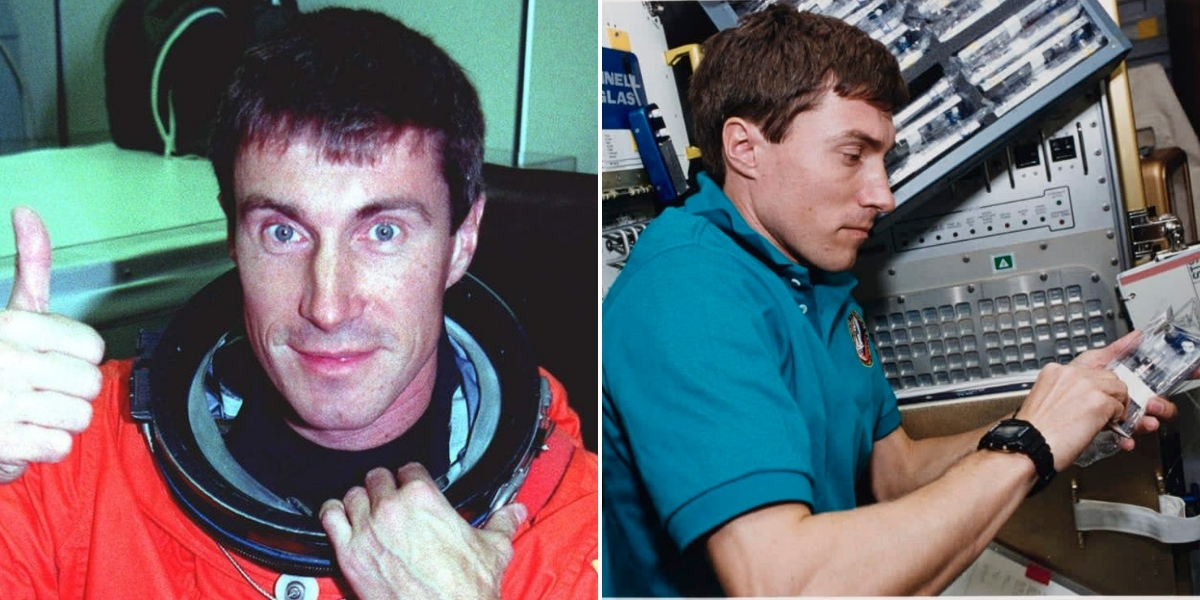
Stranded Between Earth and History: The Astronaut Who Returned to a Country That No Longer Existed

In the vast emptiness of space, where time seems to stretch infinitely and Earth is just a glowing blue marble, Russian cosmonaut Sergei Krikalev experienced a unique perspective on both human achievement and the fragility of nations. What he likely never expected, however, was that while he orbited hundreds of kilometers above the planet, the world below would change forever—and he would return to a country that had ceased to exist.
Krikalev, a skilled pilot and esteemed member of the Soviet Union’s national aerobatics team, had already demonstrated his talent and courage long before he stepped into the Soyuz spacecraft. In 1985, he had been part of the ground control team that coordinated a daring in-orbit rescue of the Salyut 7 space station after contact had been lost. Years later, he was ready for his first space mission, departing on the Soyuz TM-7 in November 1988 to the Mir space station. Over the following years, Krikalev embarked on multiple missions, ultimately spending a staggering 800 days aboard the International Space Station, a record that ranks him third behind cosmonauts Gennady Padalka and Yuri Malencheko.

By the time Krikalev launched into space on May 18, 1991, aboard Soyuz-TM 12 as part of the Juno Mission, he was still a citizen of the Soviet Union. But history was moving on without him. Political upheaval erupted on Earth, culminating in the collapse of the Soviet Union on December 26, 1991. While Krikalev floated among the stars, his homeland fractured into fifteen independent nations, Leningrad was renamed St. Petersburg, and the very notion of citizenship changed under his feet.

His stay in orbit was unexpectedly prolonged. Two planned missions had been merged due to financial constraints, meaning Krikalev, one of the most experienced astronauts, remained aboard the Mir station an extra six months. The only tether to home was semi-regular phone calls with his wife, Elena, who worked in mission control. Through her voice, he stayed connected to Earthly news and human warmth, even as the world below was undergoing a transformation more dramatic than any orbiting adventure.

Finally, on March 25, 1992, Krikalev returned to Earth, landing near the city of Arkalyk in what was now the independent Republic of Kazakhstan—without a valid passport, a reminder of just how abruptly the political map of the world had shifted. The cosmonaut had left as a Soviet citizen and returned as a Russian in a world that was no longer the one he had known.

Despite the disorienting circumstances, Krikalev has reflected on the extraordinary clarity that space gives. “From orbit, you can already see the curvature of Earth,” he told NASA. “The second surprise was to see with your own eyes that we have a pretty thin layer of atmosphere protecting us.” The photographs he took during his time in orbit were not merely beautiful—they contributed to scientific research and offered a perspective few ever get to witness.
More than that, Krikalev learned a lesson about unity and the shared human experience. “When you look down from space, it is more difficult to find things on the surface. You start to understand that our separation on Earth is more artificial. We are living on the same surface. We are more united than divided,” he said. “What we do in space together is a good example for how people should live on Earth—protecting this area, keeping a good example, showing politicians and citizens alike how we can coexist peacefully.”

Sergei Krikalev’s story is a powerful reminder of human resilience, both in the face of personal challenge and the tides of history. It is a tale of floating above Earth yet being tethered to humanity through love, duty, and hope—and of returning home to a world that had changed as profoundly as the man himself.